How to Grow Hardy Geraniums
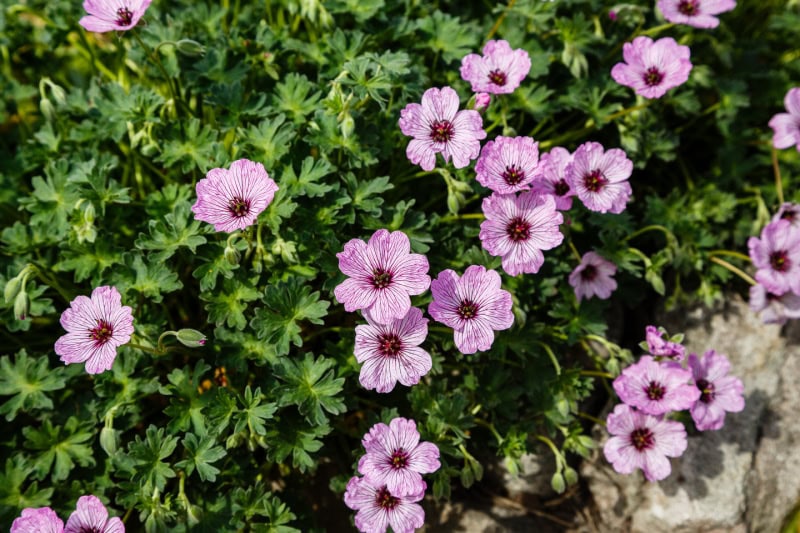
If you want a perennial that blooms for months, fills bare spots, attracts pollinators, and asks for very little in return, hardy geraniums deserve a place in your garden. Also called cranesbills, these easy-going perennials thrive in a wide range of conditions and become more beautiful with one simple midsummer pruning. Here are my best tips for growing healthy, long-blooming hardy geraniums.
This post contains affiliate links. If you make a purchase after clicking a link I may make a small commission at no cost to you.
Note: Wild Geraniums are native to much of Eastern North America and found in woodlands. You can still find them at specialty nurseries. I do encourage incorporating natives in your garden because of their benefit to pollinators and beneficial insects.
Perennial Geraniums are Super Easy to Grow
I feel almost like a fraud trying to tell you how to grow these flowers. They are so easy they just about take care of themselves.
These hardy perennials are the true geraniums. What is commonly passed off in garden centers as Geraniums are Pelargoniums aka Zonal Geraniums. They are related so I guess it is okay to call them both Geraniums.
Most hardy geraniums thrive in USDA Hardiness Zones 4 through 8, with some varieties hardy from Zone 3 to Zone 9.
What Makes Hardy Geraniums Perennial?
Like many other perennials, hardy geraniums die back in the winter to the ground, then re-emerge as the weather warms in Spring.
Do a bit of research on the hardy geranium before you bring it home. Some can be super vigorous growers that become a bully and reseed readily, coming up in areas you don’t want them to. There are even a couple that are considered invasive in certain regions.
11 Tips for Growing Hardy Geraniums
1. Plant at the Correct Depth
Plant hardy geraniums in the garden with the crown level with the soil. Burying deeper can lead to crown rot.
2. Give Them the Right Amount of Sun
Most hardy geraniums thrive in full sun to part shade, but be sure to check the label for the variety you choose. If you garden in an area with hot summers, afternoon shade will help keep the foliage fresh and the flowers blooming longer. Don’t overlook bright shade, though—many varieties perform surprisingly well there too.
3. Choose Well-Drained Soil
Hardy geraniums thrive in well-drained soil enriched with organic matter. I like to work plenty of compost into the soil before planting, which improves both drainage and moisture retention. (You can see how I enrich my garden soil here.)
4. Don’t Overwater Established Plants
During their first growing season, provide consistent moisture to encourage a healthy root system.
After they’re established, hardy geraniums tolerate short dry spells well. Their roots are concentrated in the upper layers of soil, so it’s more beneficial to thoroughly moisten the active root zone when needed than to try to force water deep into the ground. A layer of organic mulch helps keep this root zone evenly moist between waterings.
5. Skip Heavy Fertilizer
One of the biggest mistakes gardeners make is assuming more fertilizer equals more flowers.
Hardy geraniums generally require very little feeding. Excess nitrogen encourages lush green foliage at the expense of blooms and can make plants floppy.
A spring application of compost or a balanced, slow-release fertilizer is usually all that’s needed for healthy growth throughout the season.
6. Deadhead for More Flowers
Removing faded blooms encourages many varieties to continue producing flowers rather than directing energy into seed production.
While not every hardy geranium reblooms heavily from deadheading alone, it certainly keeps plants looking tidy and extends the overall display.
A quick trim every week or two during peak bloom is often enough. Within a few weeks, you’ll usually see fresh foliage followed by another flush of flowers.
7. Give Them a Midseason Haircut
This may be the single best trick for growing beautiful hardy geraniums.
After the first heavy flush of flowers, many varieties begin to look tired. The foliage may flop outward, develop brown edges, or open up in the center.
Rather than living with a messy plant for the rest of summer, simply shear the entire clump back by one-half to two-thirds.
It can feel drastic, but don’t worry.
Within a few weeks you’ll often be rewarded with fresh, compact foliage and, depending on the variety, another flush of blooms.
I use this technique every year, and it’s one of the easiest ways to keep hardy geraniums looking neat instead of overgrown.
8. Divide Every Few Years
Like many perennials, hardy geraniums eventually become crowded.
Dividing mature clumps every three to five years helps:
- rejuvenate older plants
- improve flowering
- prevent bare centers
- create free new plants for other areas of the garden
Early spring or early fall are generally the best times to divide them.
9. Pair Them with Cottage Garden Favorites
Hardy geraniums are exceptional companion plants because their softly mounding habit fills empty spaces and hides the bare stems of taller perennials.
Some beautiful companions include:
- Roses
- Salvias
- Shasta daisies
- Yarrow
- Catmint
- Foxgloves
- Peonies
- Delphiniums
- Nepeta
- Echinacea
Their relaxed growth habit helps soften garden edges while weaving neighboring plants together into a natural-looking planting.
10. Expect Some Self-Seeding—but Not Aggressive Spreading
Some hardy geranium species may self-seed lightly if flowers are left on the plant.
Fortunately, they’re rarely considered invasive in the garden. (Research the plant you are looking at, there are a couple that are considered invasive in some regions)
If you don’t want volunteer seedlings, simply remove spent flowers before seed develops.
Some gardeners actually welcome the occasional seedling because they’re easy to move to another location or share with friends. I don’t, as with the hybrids I grow the seedlings don’t usually have the characteristics that make the parent plant desirable.
11. Choose the Right Variety
There are hundreds of hardy geranium species and cultivars, each with its own strengths.
Some of my favorites include:
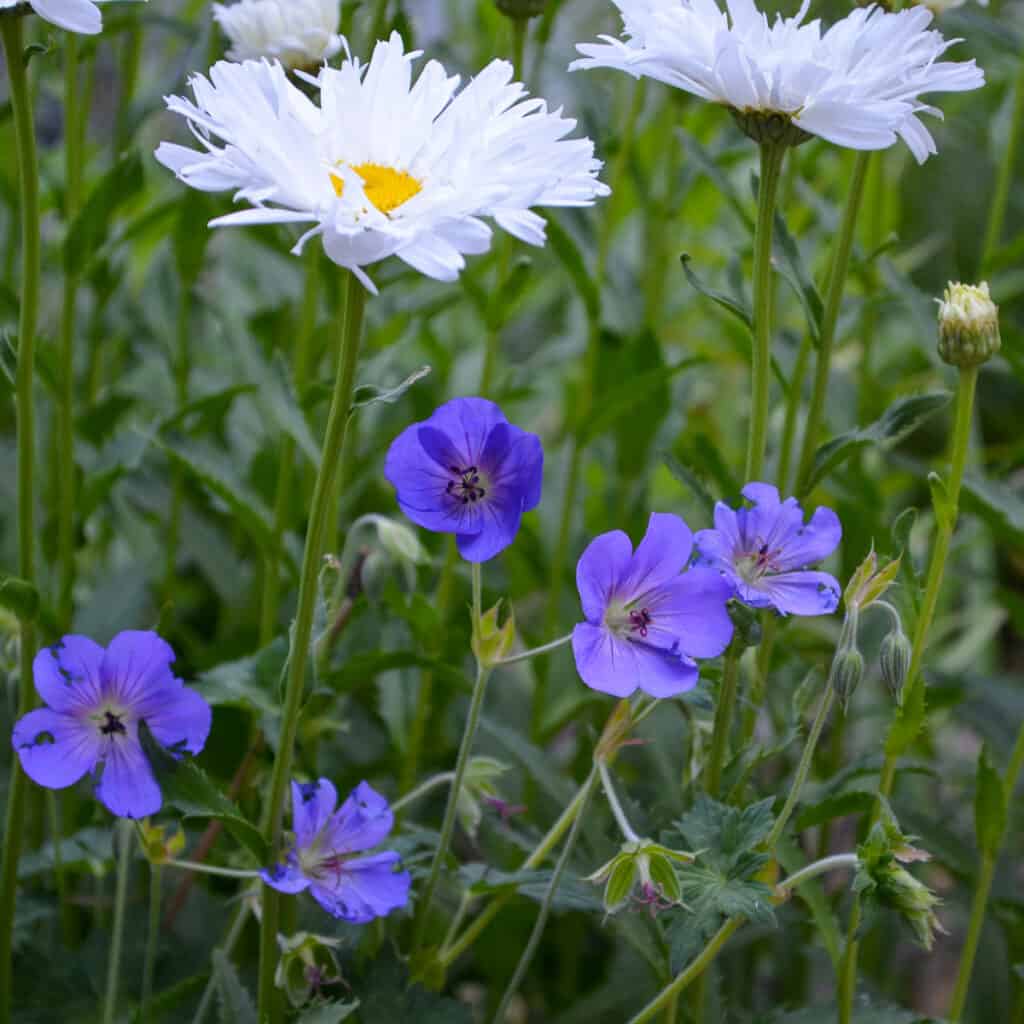
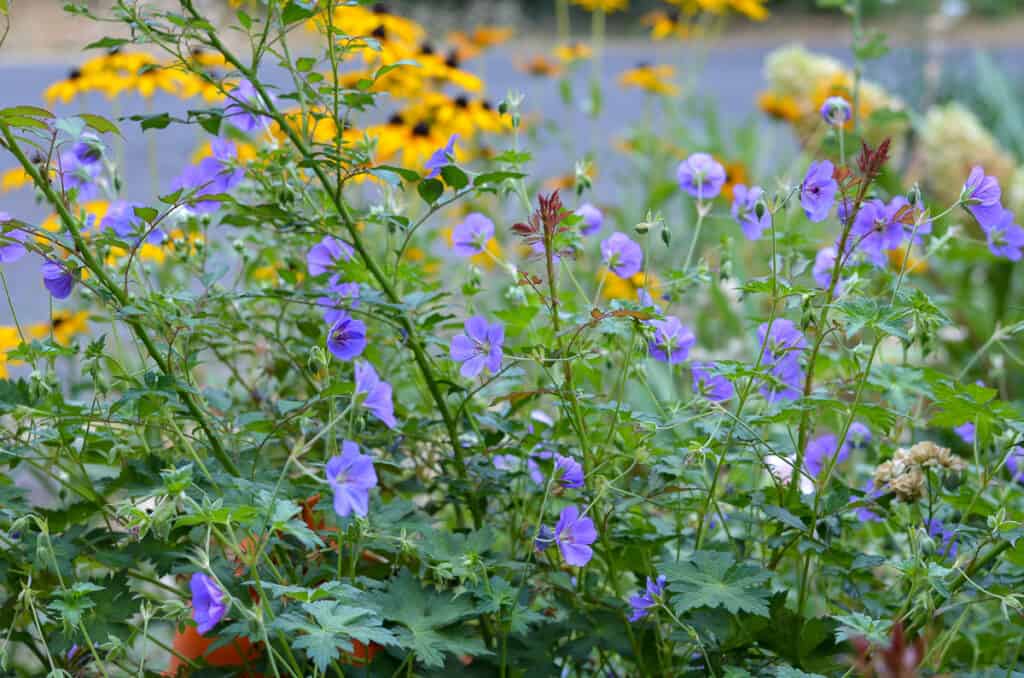
- Rozanne – famous for blooming from late spring until frost with violet-blue flowers.
- Johnson’s Blue – a classic variety with beautiful blue blooms in late spring and early summer.
- Biokovo – an excellent groundcover with soft pink-white flowers.
- Elke – compact and ideal for edging paths.
- Tiny Monster – forms a colorful mound with rosy-pink flowers.
Choose a variety based on your available space, bloom time, and sun exposure rather than simply flower color.
Tiny Monster certainly earned its name in my garden. I originally planted it beneath one of my roses, but before long it was trying to swallow the rose whole! Fortunately, it responds beautifully to a midsummer haircut and comes right back with fresh growth.
Dividing or propagating hardy cranesbill geraniums
Discover How Easy It Is!
Perhaps the greatest strength of hardy geraniums is how little work they require compared to the beauty they provide.
Once established, they offer:
- months of attractive foliage
- colorful blooms
- pollinator-friendly flowers
- excellent weed suppression
- minimal pest problems
- adaptability to sun or part shade
- reliable performance year after year
For gardeners looking to create a relaxed cottage garden that doesn’t require constant maintenance, hardy geraniums are hard to beat.
Happy Gardening!
Please feel free to PIN and share

Hi, I’m Pamela
With 45 years of hands-on gardening experience, I love sharing practical tips, proven techniques, and inspiration drawn from my own gardens. My goal is to nurture your confidence, spark your passion, and help make every step of your gardening journey more enjoyable.


I have Tiny Monster and Rosanne both planted across the front of my South facing house. Due to trees, there are periods of shade in the morning and late afternoon. I’ve noticed the Tiny Monster is not bothered by the mid-day afternoon sun and heat, but the Rosannes’ leaves tend to curl up as if they have wilted every day. Have you noticed if Rosanne needs more shade or more water? Located in Maryland, we have high humidity and summer temps will be climbing into the high 90’s. I’m wondering if I should moved the Rosannes, and what I should replace them with that will tolerate heat/sun like Tiny Monster.
Mine do. All of my hardy geraniums do and I cut them back to the ground. So that answer is yes.
I am five miles inland in Orange County, Southern California. Do Cranesbill Johnson Blues die back to the ground in winter? This is my first year growing them and I am wondering if I should cut them to the ground and plant winter flowers till they return in Spring.
Well then the rain this weekend will be a good shot of water for them to help get the established. Good planning. 🙂
I have the palest one (like in your last photo). Love the deeper colored ones. I will keep on a lookout for some of those. I just brought some from my bay area garden to the cabin and, dividing the clump into 4 pieces, transplanted them there last week. oh boy!
I use a slug bait that works well for me and it is safe for organic gardening. Here is the link that takes you to Amazon. http://amzn.to/1RAJEpL This is an affiliate link. You can also find this at many local garden centers. I think there are several brands that are made from the same thing. But it works well for me.
The lack of sun may be what is causing your Cranesbill to struggle. Try moving one to a sunnier location and see if that fixes the problem, they will know for sure. Hope this helps.
I planted some Crainsbill late last summer. They looked like they were struggling. I am hoping they do better this summer. I live in Michigan. I am a little iffy about where they are planted. They are in mostly shade until about 3 or 4 pm. Do you think this is not enough sun?
Can you tell me any tips on how to wipe out slugs? The last 2 springs we had and infestation of them. They are so icky! I really don’t want to be our there with my rubber boots and spray bottle attacking each and every one like I did last year. I ended up having dreams about them!
Everybody needs something easy and reliable to grow and I don’t know that many really know about these garden lovlies.
Nice post. I grow geraniums also. They are very easy to care for and very hard in my region. Thanks for sharing.